Garage Doors
Owner's notes
Good advice is worth more than a sales pitch. In this section we explain how doors and openers work, what wears out and why, and how to tell a small job from a big one.
Questions and answers
Will you tell me if the door should not be used?
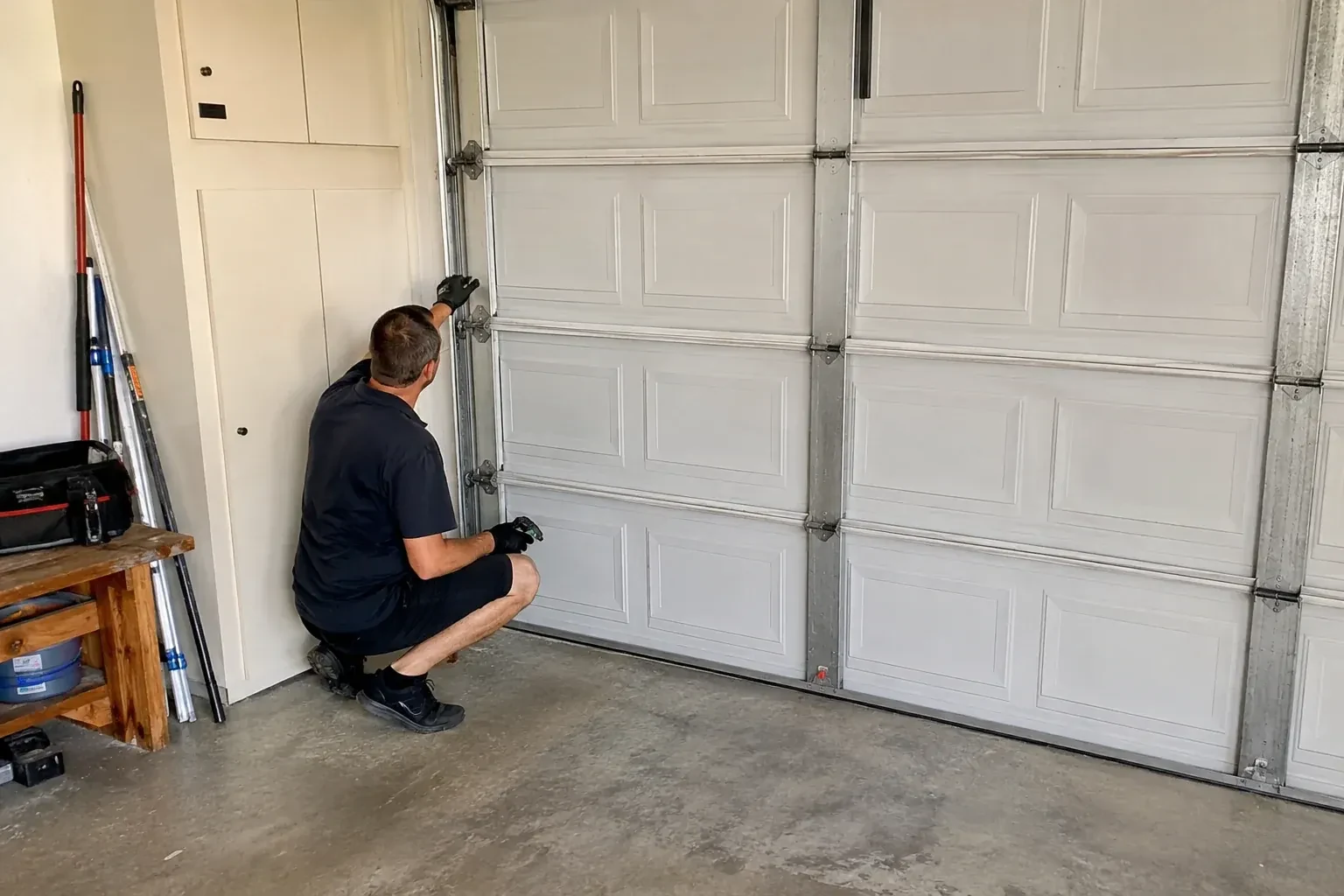
Yes, plainly and at the door. A slack or frayed cable, a gap in a spring coil, a door hanging crooked, a bracket pulling out of the framing or an opener that fails the reversal test are the kinds of findings that put an item in the stop-use group. When that happens you see the reason yourself, the door is left resting in a safe spot with the opener unhooked, and the fix is written up and quoted so it can be booked.
How do I test the safety reversal at home?
Two tests, once a month. With the door open, press close and wave a broom handle through the photo-eye beam near the floor: the door should stop and go back up. Next, set a 2x4 flat on the concrete in the middle of the opening and press close: the door must reverse when it meets the board. If it stops on the board without reversing, the down travel or force setting needs adjustment, and if it fails after that, book a visit.
Why did the door come off its track in the first place?
The usual causes are an impact from a vehicle, a lifting cable that broke or slipped off its drum, ice holding the door to the floor while the opener pulled, an obstruction under the door, worn rollers that no longer hold in the rail, or track brackets that have loosened from the wall. Finding which one applies is the first part of the visit, because the reset is only durable once the cause is corrected.
Can a dent be repaired instead of replacing the section?
Sometimes. A shallow dent in the middle of a steel skin, away from joints and hinge points, can often be eased out or filled, sanded and painted. Damage that creases the metal, reaches a joint or an end stile, bends a hinge point, or kinks a strut affects how the section carries load as the door moves, and a new section is the sound repair there. The technician tells you which category your dent falls into.
Will I need a new retainer as well as a seal?
Only if the existing one is damaged, and most are reused. A retainer that is straight, tight to the rail and free of heavy corrosion stays. One that has been kinked by a bumper or shovel, spread open so the seal slips out, or eaten by salt is replaced with a matching aluminum extrusion so the new seal seats properly. The inspection at the start of the visit settles which applies.
The wood around my door is rotten near the floor. Can the seal still go on?
Yes, and the rot is handled first. The soft wood at the base of the jamb is cut back to sound material and a new piece of lumber or PVC trim is spliced in, fixed and primed, so the fasteners for the new stop bite into something solid. This is one of the most common additions to a perimeter seal job here, because slush and salt sit against the jamb base all winter.
Why does the inside knob spin without doing anything?
The knob is meant to grip the square spindle with a set screw, and that screw has loosened or the spindle's flat has worn so the knob no longer bites. Sometimes the spindle itself has sheared inside the door. The technician tightens a fresh set screw onto a proper flat or fits a new spindle of the correct length, and the knob and outside handle move as one again.
How many rollers does a garage door have?
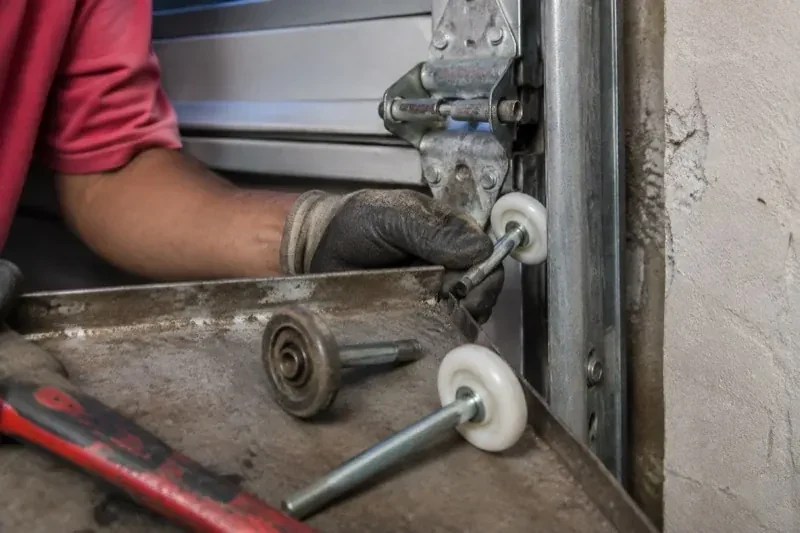
A standard four-section residential door has ten: one at each end of the three hinge lines between sections, one in each of the two top fixtures and one in each bottom bracket. A five-section door carries twelve, and taller doors more still. The technician counts and inspects every one, because replacing the full set together keeps the door's travel and sound even from side to side.
What do the numbers stamped on garage door hinges mean?
They mark the joint the hinge belongs to, counted from the bottom. A 1 goes at the joint above the bottom panel, a 2 at the next one up, then 3, with 4 and 5 on taller doors. Each higher number stands the roller a little further off the door face, so the door leans into the jambs when closed and follows the track as it climbs. Centre hinges use the geometry of a 1.
What is the flag bracket and why does it matter?
The flag bracket is the L-shaped angle at the top of each vertical track. It ties the vertical run, the curve and the horizontal track together, and on a torsion-spring door it also carries the end bearing plate for the spring shaft. Because so much meets there, a loose or bent flag bracket throws the whole path off. The technician unloads the springs before moving it and squares it carefully when it goes back.
Can I use the door as soon as the work is finished?
Yes. The visit ends with the door balanced by hand, run through full cycles and the opener reconnected and tested, so it is ready for normal use the moment the technician packs up. There is no settling period for cables. It is a good idea to watch the first few openings yourself to get a sense of how a level, balanced door sounds, so you notice any change later.
How can I tell if my springs are wearing out before they break?
Watch for a door that feels heavier by hand when the opener is released, an opener that strains or slows, a door that drops the last stretch rather than settling, or one that drifts down when stopped halfway. Visually, look for stretched gaps between coils, rust streaks or pitting on the steel, and any sag in the shaft. A balance check when you notice these lets you plan a replacement rather than react to one.
What can I do to make the new springs last?
Three things. Spray the springs, pulley axles and hinges with a garage-door lubricant twice a year, which slows rust in an unheated garage. Keep the threshold clear of bins and packed snow so the door never stops short with the springs still pulling. And leave the opener's force setting where the technician put it, since a door that starts needing more push is a balance question rather than a dial to turn.
Why does my door drift upward when I let go of it?
Too much spring tension. The springs are pulling harder than the door weighs, so at rest they win and the door climbs. This often follows a spring replacement wound a turn too far, or a door that lost weight when heavy panels were swapped for lighter ones. Releasing a quarter turn or two, tested after each, brings it back to holding still.
What is the red cord for, and is it safe to pull?
It is the emergency release that disconnects the door from the opener so you can move it by hand, for instance during a power outage. It is safe when used with the door closed. Pulling it with the door open is the risk, because an unbalanced door can then drop. Pull straight down, lift the door by its handle, and reconnect afterwards by running the opener or lifting until the trolley clicks back in.
What does it mean when the drive is out of phase?
The motor keeps track of the door's position by counting its own turns, and the trolley is meant to be at the closed end of the rail when the motor is at its closed position. If the operator has been run with the chain off the sprocket, or a chain was refitted at random, the two no longer agree and the door travels partway however the limits are set. Re-phasing means finding the motor's closed position and refitting the chain with the trolley closed.
What is the difference between belt-drive repair and opener replacement?
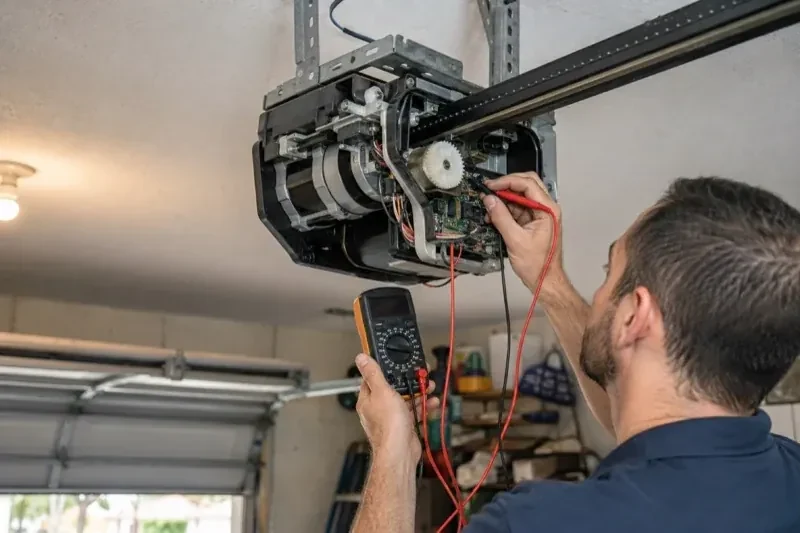
Repair keeps the operator you have and renews the piece of the drive that has failed: the belt, its tension, the trolley, the idler pulley or the gear and sprocket at the motor head. It suits a unit with a sound motor and board, photo eyes near the floor and rolling-code remotes. Replacement is the answer when the operator predates those features or when its board or motor has failed and is no longer made.
Why does the technician test the door by hand before anything else?
Because the opener depends on the springs. With the old unit disconnected, a balanced door lifts with moderate effort and stays put at roughly waist height. A door that drops or drifts is telling the technician the springs need adjusting, and doing that first means the new operator is never asked to haul a heavy door, which would shorten its life and mask a problem that belongs to the door.
My opener has no sensors at all. Can they be added?
If the opener predates the entrapment-protection standard, which operators have had to meet since the mid-1990s, its board has no sensor circuit and a pair cannot simply be wired in. The positive news is that a modern operator brings the whole package: matched sensors, force reversal and a monitored circuit. The technician confirms the model first, because some units do have the terminals and simply had their sensors removed.
Why won't the new remote I bought pair with my opener?
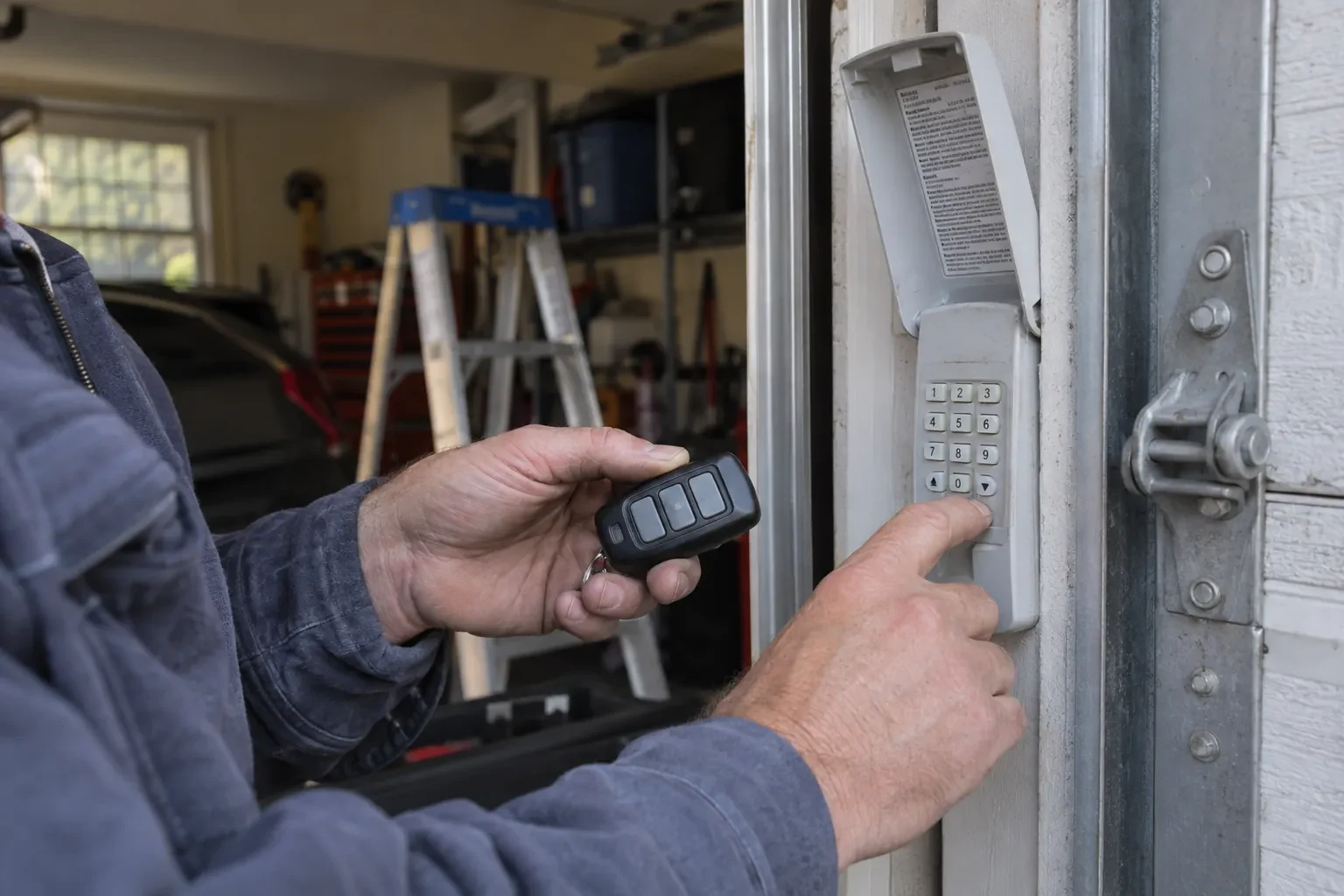
Most often because it belongs to a different radio generation. Openers have changed their radio format several times since the mid-1990s, and a remote built for one format is silent to a receiver from another. On many makes the colour of the learn button, together with the model label, identifies your generation, and the maker's compatibility chart names the remotes that match. A universal remote that covers several generations is another route. Once the two sides share a format, pairing takes moments.
My opener already has a wireless symbol on it. Do I still need a hub?
Probably not. An opener with a built-in radio needs only to be put into pairing mode, joined to your network and registered to your account; it reports door position from its own travel sensing, so no separate sensor is required either. The visit becomes configuration and testing rather than installation. The technician also checks that the unit has not been left tied to a previous owner and that its firmware is current.
Why does the trolley run but never reconnect to the door?
Three usual causes. On many rails, pulling the cord back toward the opener deliberately holds the lever out for a spell of manual use, and someone forgot to return it. Or the trolley latch teeth or the release arm are worn or bent, so the two parts pass without catching. Or the carriage sits at the wrong point for the powered trolley to meet, since reconnecting is meant to happen during an opener cycle, not by pushing the door shut by hand. Each is a short fix once identified.
Can replacement work with a low ceiling?
Often, provided the opening and overhead space are measured before ordering. Low-headroom track and other model-supported arrangements can change how the upper section moves through the curve and where counterbalance parts sit. The technician maps beams, pipes and the operator rail, then selects from configurations supported for the particular door.
How should painted steel sections be cleaned?
Use the care method provided for the selected finish. Common guidance involves mild soap, clean water and a soft cloth or sponge, followed by a thorough rinse. Work on a cool surface and avoid abrasive pads that can mark the coating. Seasonal washing removes road film and winter residue while giving you a chance to notice scratches, seal wear or developing corrosion.
How do insulation and weather seals fit into the project?
Insulated section construction can add stiffness, comfort, and weight, while perimeter seals limit drafts and ordinary moisture entry around the closed door. These choices are coordinated with the wind-rated configuration rather than selected separately. Bottom seal contact, side weatherstrip, and top seal alignment are checked during handover so the reinforced assembly also closes neatly for daily use.
How should I choose the panel pattern for my house?
Start with fixed proportions already on the exterior: window widths, masonry lines, roof shapes, columns and entry-door details. A simpler pattern can settle a busy elevation, while cross-buck or divided-panel designs add stronger character to a plain wall. Scale matters across wide doors, so the pattern should be viewed as a full-opening drawing or sample rather than a small swatch alone.
How should I clean the glass and aluminium frame?
Follow the care instructions for the exact glazing and finish. First rinse away grit and winter residue, then use a soft cloth or sponge with the approved mild solution. Acrylic, polycarbonate, coated glass and anodized or painted aluminium can have different restrictions. Clean with the door closed and prevent control operation while anyone is working near the sections.
Is an insulated garage door worthwhile for this project?
Insulation is especially relevant when the garage is heated, attached to living space or intended as a workshop. Door construction, section joints, glazing and perimeter seals all influence the enclosure, so an insulated section alone is only one part of the decision. The chosen thermal performance should be compared on consistent product information, then coordinated with door weight because the counterbalance system must match the completed assembly.
Can corrosion on lower hardware be repaired?
Surface condition and remaining material determine the scope. Light contamination may be cleaned during maintenance, while pitted cables, weakened brackets, seized rollers or compromised fasteners are replaced with compatible components. The source of moisture is considered too. Clearing drainage, renewing seals and removing accumulated salt help protect the repaired lower section and its hardware.
How should we prepare the loading area?
Move vehicles, pallets and loose packaging away from both faces of the opening, and identify an alternate route for staff and deliveries. Provide access to the control station, disconnect and any door records. A facility contact who understands normal operation and can authorise testing makes it easier to reproduce the complaint under controlled conditions.
Does cold weather affect a high-lift system?
Cold, moisture and road salt can influence metal surfaces, seals and lubrication just as they do on other garage doors. The taller track path also makes unobstructed movement and correct cable winding important to observe. Follow the installed door and opener manuals for seasonal care, keep lower hardware clean, and arrange service when movement or sound changes noticeably.