Springs · Kennedy Park
Extension Spring Replacement in Kennedy Park
A bang like a dropped toolbox came from the garage last night.
In plain words
A spring visit follows a fixed order, so you know what to expect. The technician releases the opener, raises the door fully and clamps it, because an extension spring is at its slackest with the door open. Then both springs, the pulleys, cables, hangers and containment cables are inspected and the door is weighed. Old springs come off, new ones go on with containment cables threaded through, cables are routed over the pulleys and both sides are hooked at the same setting. The clamps come off, the door is balanced by hand, and only then is the opener reconnected, adjusted and put through its reversal tests.
How the visit goesIt is the first hard frost of the year and the door on the old detached garage has stopped halfway, squealing at one pulley. The springs are the ones that came with the door decades ago, orange with rust where they hang near the back wall.
Extension Spring Replacement
How the visit goes
Weighing the door
Extension springs are chosen by the weight they are built to lift, so the door is weighed rather than guessed at. With the opener released and the springs disconnected or slack, the technician lowers the door onto a scale set on the floor under the bottom section and reads the figure. That number, together with the door's height, sets the spring rating and stretch length. The old springs are measured as a cross-check, but the scale wins if the two disagree, because a door can gain weight from new panels, insulation or a cladding added since the springs went on.
Threading the containment cables
Before a spring is hung, a containment cable is fed through the centre of its coil. One end is anchored at the rear, to the hanger or the framing behind it, and the other is run forward past the pulley and fixed to the bracket at the front of the track or to the wall, with enough slack that the cable never carries load while the spring works. The cable is checked to be clear of the pulley wheel and the lift cable so nothing rubs. Both sides are done the same way, whether or not the old installation had them. A spring that breaks in future is held on the cable rather than crossing the garage.
Checking the balance yourself
You can confirm the springs are still doing their share without going near them. With the door closed and nobody in the opening, pull the opener's red release cord so the trolley lets go of the door. Lift the door by its handle to roughly hip height and take your hands away. A door on good springs stays about where it is; if it sinks to the floor the springs have weakened, and if it rises on its own they are pulling harder than the door weighs. Either way it is a call rather than a job for you. Reconnect the opener the way your manual describes, usually by running it once.
Extension Spring Replacement
In the van
Containment (safety) cables
Bottom brackets and clevis pins
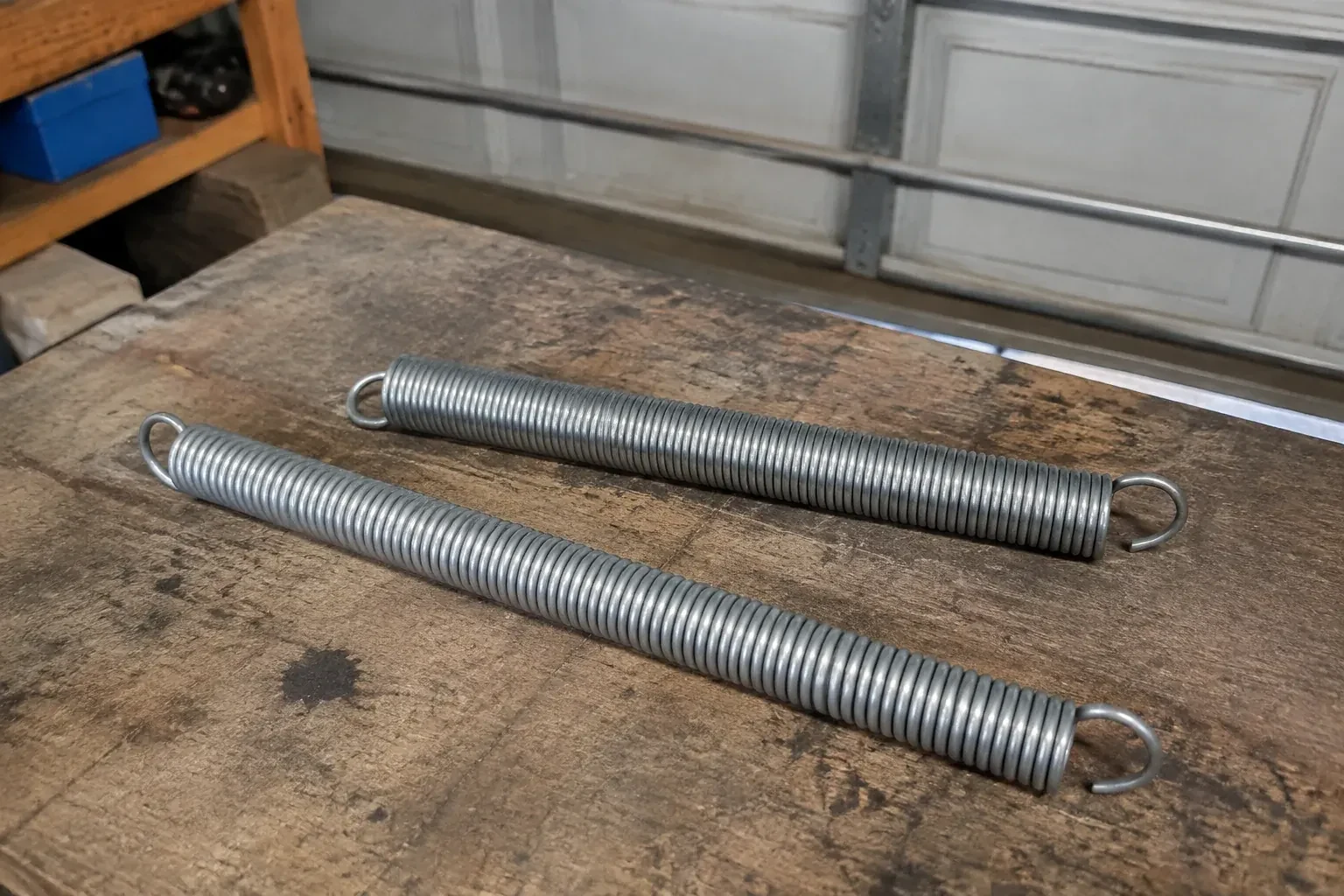
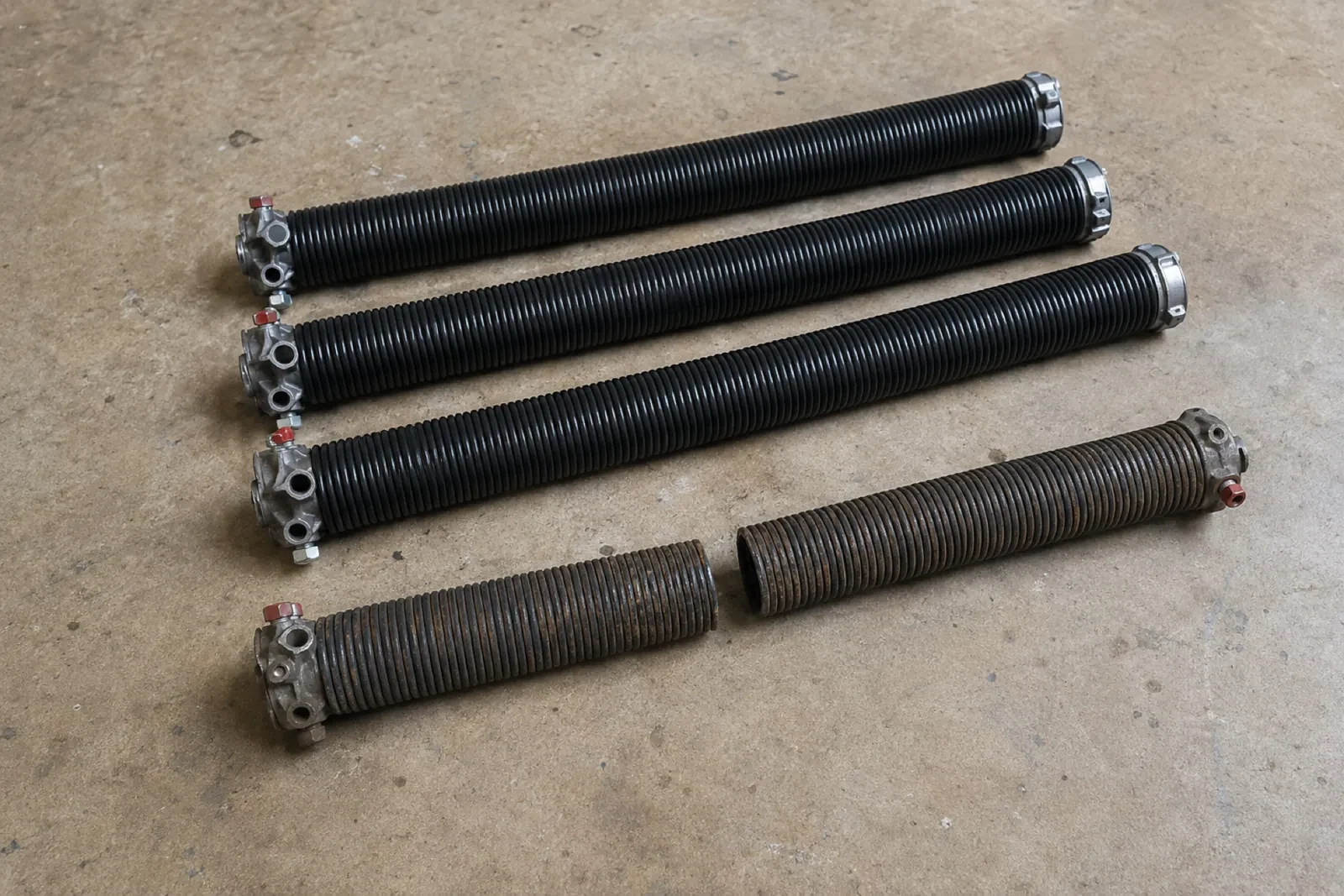
Extension springs, matched pair
Lift cables
Rear spring hangers and angle iron
Extension Spring Replacement
What affects the quote
How the door is sitting
A door resting closed with one spring gone is straightforward. A door stuck partway, twisted in its tracks or with a cable wrapped around a pulley has to be supported and straightened first.
Track or section damage found on the way
A bent horizontal track, a bracket pulled off the jamb or a top section twisted by running the opener on a broken spring is separate repair work, quoted on its own.
Hangers and anchor points
A rear hanger that has loosened, a front bracket bent by a jumped cable, or framing that needs a new anchor point adds fasteners, angle iron and a little time.
What to have ready
- Does one corner of the door hang lower than the other?
- Do the springs run along the tracks beside the door, or is there one spring above the opening?
- Is a car parked inside that will need to come out first?
Extension Spring Replacement: questions
QuestionsWhat can I do to make the new springs last?
Three things. Spray the springs, pulley axles and hinges with a garage-door lubricant twice a year, which slows rust in an unheated garage. Keep the threshold clear of bins and packed snow so the door never stops short with the springs still pulling. And leave the opener's force setting where the technician put it, since a door that starts needing more push is a balance question rather than a dial to turn.
Only one spring broke. Why replace both?
The two springs are the same age and have stretched the same number of times, so the one still hanging is close behind. There is also a balance reason: a door lifts level only when both sides pull equally, and a new spring beside a worn one lifts its corner first and twists the door. Fitting a matched pair sets both sides the same and avoids a second visit a few months on.
What is the difference between extension springs and torsion springs?
They balance the door in different places. Extension springs are the two long coils that run beside the horizontal tracks and stretch as the door closes; they work through pulleys and cables. A torsion spring is wound on a shaft above the door opening and turns drums that wind the cables. The parts, the way tension is set and the service itself are different, so it helps to say which you have when you call.